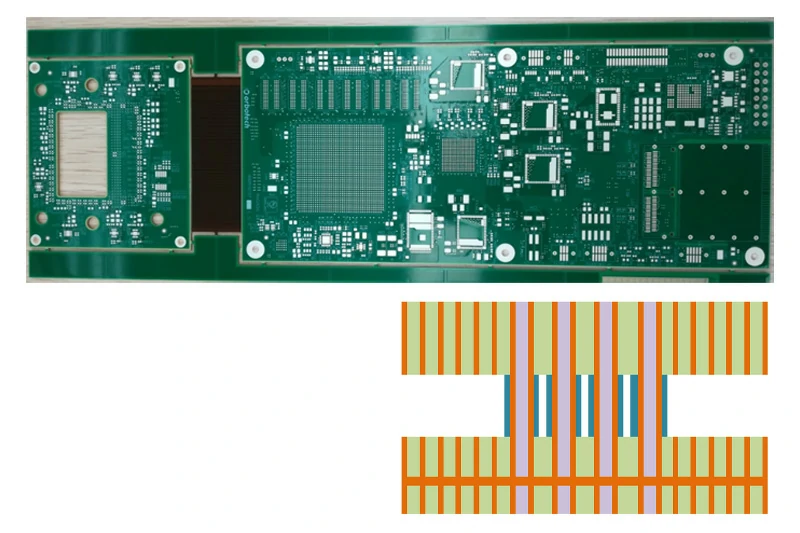
The typical thickness of a rigid-flex PCB is not a single standard number; instead, it varies widely based on the application’s specific requirements. Generally, the rigid sections range from 0.4mm to 3.2mm (0.016″ to 0.125″), similar to standard rigid boards, while the flexible sections are significantly thinner, typically between 0.05mm and 0.4mm (0.002″ to 0.016″). The final thickness is a carefully engineered outcome determined by factors like layer count, material selection, copper weight, and the required bend radius for the flexible parts.

Table of Contents
- The Core Concept: Why There’s No “One-Size-Fits-All” Thickness
- Breaking It Down: Thickness of Rigid vs. Flex Sections
- What Are the Key Factors That Determine Rigid-Flex PCB Thickness?
- Visualizing the Stack-up: Sample Rigid-Flex Thickness Configurations
- How to Determine and Specify PCB Thickness for Your Project
- Conclusion: Thickness as a Critical Design Parameter
The Core Concept: Why There’s No “One-Size-Fits-All” Thickness
Unlike a standard rigid PCB where thicknesses like 1.57mm (0.062 inches) are a common default, rigid-flex circuits are inherently custom-built. Their primary advantage lies in their ability to conform to three-dimensional spaces, which necessitates a design-specific approach. The thickness is not a starting specification but rather the *result* of a series of critical design decisions. Each part of the board—the unbending rigid sections that support components and the pliable flex sections that act as integrated cables—has its own unique thickness requirements driven by its function.
The fundamental misunderstanding is to think of a rigid-flex board as having a single, uniform thickness. It is a hybrid construction where different areas have different profiles. The transition between the rigid and flex areas is a critical zone of mechanical stress that must be carefully managed. Therefore, thinking in terms of “typical thickness” can be misleading. A more productive approach is to understand the variables that construct the final thickness and how to manipulate them to achieve your product’s goals for performance, reliability, and form factor.
Breaking It Down: Thickness of Rigid vs. Flex Sections
To properly analyze the thickness of a rigid-flex PCB, we must dissect its two distinct components. The needs of the rigid area, which provides mechanical support and a stable platform for components, are vastly different from the needs of the flex ribbon, whose main purpose is to bend and route signals in tight spaces.
Understanding Rigid Section Thickness
The rigid sections of a rigid-flex board are structurally analogous to conventional PCBs. Their primary function is to house the majority of the electronic components, connectors, and processing units. Consequently, their thickness is dictated by the need for mechanical stability and the complexity of the circuitry within.
- Common Range: Typically, rigid sections fall between 0.4mm and 3.2mm (0.016″ to 0.125″).
- Key Drivers: The thickness is largely a function of the number of layers required. A simple board might have 4 or 6 layers, while a complex device like a high-end smartphone or server board can have 12 or more layers in its rigid sections. More layers mean more sheets of core material (like FR-4) and prepreg, directly increasing the overall thickness. Furthermore, heavy components or large BGA (Ball Grid Array) packages require a thicker, more robust board to prevent warpage and ensure solder joint integrity.
Decoding Flex Section Thickness
The flexible part of the board is where the true innovation of rigid-flex design lies. Here, the primary goal is not rigidity but *pliability*. The thinner the flex circuit, the more flexible it becomes, and the tighter its potential bend radius.
- Common Range: The flex section thickness usually varies from 0.05mm to 0.4mm (0.002″ to 0.016″).
- Key Drivers: The most critical factor is the required flexibility, often defined by the *bend radius*. A dynamic application where the circuit will be flexed repeatedly (e.g., in a hinge) demands a much thinner and more durable flex section than a static “bend-to-install” application. A single-layer flex circuit will be the thinnest and most flexible option, while a multi-layer flex section, though offering more routing density, will be thicker and less pliable. The choice between adhesive-based and adhesiveless materials also plays a crucial role, with adhesiveless constructions offering a thinner profile.
What Are the Key Factors That Determine Rigid-Flex PCB Thickness?
The final dimensions of a rigid-flex PCB are a complex interplay of electrical, mechanical, and manufacturing considerations. A designer must balance these competing factors to create a functional and reliable product. Understanding these elements is essential for effective communication with a PCB fabricator.
Number of Layers (The Primary Driver)
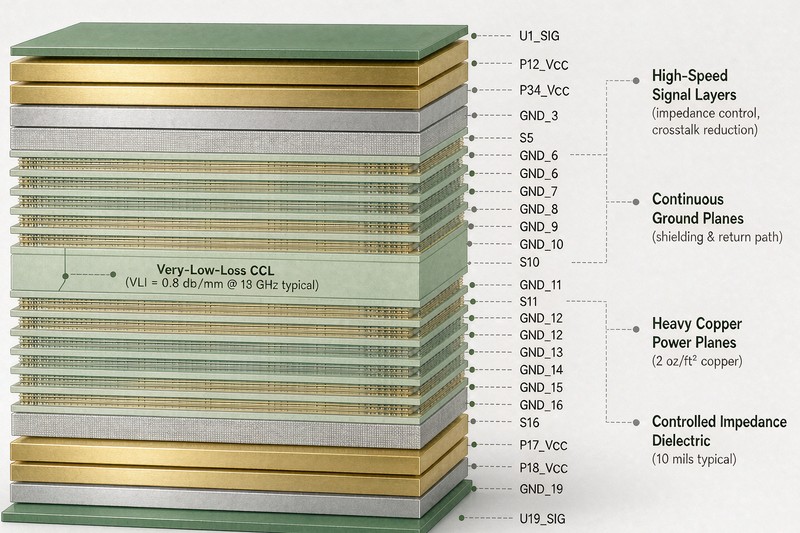
The single most significant contributor to PCB thickness is the layer count. Each conductive copper layer must be separated by a dielectric (insulating) material. In rigid sections, this stack-up consists of cores and prepregs. In flex sections, it’s polyimide cores and coverlays or flexible soldermask. More layers mean more routing capacity and better signal integrity through ground planes, but it comes at the direct cost of increased thickness, weight, and manufacturing complexity.
Material Selection and Its Impact
The type of materials used forms the very foundation of the board’s stack-up and, therefore, its thickness. Different materials are chosen for the rigid and flex sections to optimize performance.
- Core and Prepreg Materials: For rigid parts, standard FR-4 is common, but high-frequency or high-temperature applications may demand specialized materials like Rogers or Isola, which come in specific thicknesses. The thickness of the prepreg sheets used to bond the layers together can be adjusted by the manufacturer to meet overall thickness targets or impedance requirements.
- Flexible Core Materials: The universally used material for flex circuits is Polyimide (PI). It is available in various standard thicknesses, such as 0.5 mil, 1 mil, and 2 mil (12.5μm, 25μm, 50μm). The choice of PI thickness is a direct trade-off between durability and flexibility.
- Adhesive vs. Adhesiveless Construction: Traditional flex circuits use an acrylic adhesive to bond the copper foil to the polyimide core. However, modern adhesiveless materials, where copper is directly cast onto the polyimide, eliminate the adhesive layer. This results in a thinner, more flexible, and more thermally stable circuit, which is highly preferred for dynamic applications and fine-pitch designs.
- Coverlay vs. Flexible Solder Mask: The outer layers of the flex circuit need protection. Coverlay, a laminated sheet of polyimide with adhesive, is a robust and durable option but adds more thickness. Flexible liquid photoimageable (LPI) solder mask is a thinner alternative, but it is less durable and may crack under repeated bending.
Copper Weight and Trace Dimensions
Copper weight, measured in ounces per square foot (oz/ft²), defines the thickness of the copper layers. Standard copper weights are 1 oz (35µm) and 0.5 oz (18µm). Applications requiring high current-carrying capacity may need 2 oz or even heavier copper, which will proportionally increase the thickness of each copper layer and the overall board profile. Thicker copper also requires wider trace and space geometries, which can impact routing density on compact designs.
Controlled Impedance Requirements
High-speed digital signals (e.g., USB, HDMI, Ethernet) require a specific characteristic impedance, typically 50 or 100 ohms, to maintain signal integrity. This impedance is a function of the trace width, the dielectric constant of the material, and the distance between the trace and its reference plane (dielectric thickness). To achieve a target impedance, manufacturers must use specific material thicknesses. Therefore, if your design includes controlled impedance traces, this requirement will heavily constrain and often dictate the thickness of the dielectric layers, and by extension, the total board thickness.
Mechanical and Performance Requirements
Finally, the physical and environmental demands on the board play a pivotal role.
- Bend Radius and Flexibility: This is arguably the most critical mechanical constraint for the flex section. There are rules of thumb for minimum bend radius to prevent damage:
- Static (Bend-to-install): 6x to 10x the flex section thickness.
- Dynamic (Repeated flexing): 20x to 40x the flex section thickness.
This means that to achieve a very tight bend, you *must* design a very thin flex section, often by limiting it to one or two layers and using adhesiveless materials.
- Component Support: A thick rigid section provides better support for heavy or sensitive components, preventing stress on solder joints during shock or vibration.
- Via and PTH Aspect Ratio: The aspect ratio is the ratio of the board’s thickness to the diameter of a drilled hole. Manufacturers have limits on the maximum aspect ratio they can reliably plate (e.g., 10:1). This means a very thick board will require larger minimum drill holes, which can affect routability.
Visualizing the Stack-up: Sample Rigid-Flex Thickness Configurations
To make these concepts concrete, let’s examine a couple of simplified sample stack-ups. These tables illustrate how the individual material thicknesses add up. Note: These are illustrative examples; actual thicknesses will vary based on the manufacturer’s specific materials.
| Layer Type | Material | Typical Thickness (mm) | Applies To |
|---|---|---|---|
| Layer 1 (Outer) | Copper (1 oz) | 0.035 | Rigid |
| Prepreg | FR-4 | 0.20 | Rigid |
| Layer 2 (Inner) | Copper (0.5 oz) | 0.018 | Rigid + Flex |
| Flex Core | Polyimide (Adhesiveless) | 0.050 | Flex |
| Layer 3 (Inner) | Copper (0.5 oz) | 0.018 | Rigid + Flex |
| Prepreg | FR-4 | 0.20 | Rigid |
| Layer 4 (Outer) | Copper (1 oz) | 0.035 | Rigid |
| Total Rigid Thickness (Approx.) | ~0.56mm | (Excluding solder mask) | |
| Total Flex Thickness (Approx.) | ~0.086mm | (Excluding coverlay) | |
How to Determine and Specify PCB Thickness for Your Project
With a clear understanding of the factors involved, the next step is to apply this knowledge to your specific design project. This process is one of collaboration and careful specification.
The Golden Rule: Collaborate with Your Manufacturer
The single most important step in designing a rigid-flex PCB is to engage with your chosen fabricator early and often. This practice, known as Design for Manufacturability (DFM), can save you from costly redesigns and production delays. Your manufacturer has intimate knowledge of their materials, capabilities, and process limitations. Provide them with your preliminary design and requirements, and they can offer a feasible stack-up that balances your performance needs with manufacturing reality and cost.
Defining Your Requirements
Before you approach a manufacturer, you should have a clear set of answers to the following questions. This will facilitate a much more productive conversation.
- What is the total layer count for the rigid and flex sections? (e.g., 6 rigid layers, 2 of which extend into the flex area)
- What are the mechanical constraints? Specifically, what is the minimum bend radius required for the flex cable? Will it be bent once for installation or flexed dynamically?
- Are there any controlled impedance requirements? If so, what are the target impedance values (e.g., 50-ohm single-ended, 100-ohm differential)?
- What are the current-carrying requirements? This will help determine the necessary copper weight.
- What is the overall desired thickness or profile for the final product? This is your target that the manufacturer will try to meet.
Understanding Tolerances
It’s crucial to remember that PCB manufacturing is not an exact science, and finished board thickness will always have a tolerance. A typical industry standard for overall thickness tolerance is ±10%. This means a board specified at 1.0mm could measure anywhere from 0.9mm to 1.1mm. If your design has strict mechanical clearance requirements, you must account for this tolerance range to avoid fitment issues in your final assembly.
Conclusion: Thickness as a Critical Design Parameter
Ultimately, the question “What is the typical thickness of a rigid-flex PCB?” is best answered with: *it’s the thickness your design needs it to be*. There is no magic number. The thickness of a rigid-flex board is a critical design parameter that emerges from a careful balance of electrical requirements, mechanical constraints, and material science. By differentiating between the needs of the component-laden rigid sections and the pliable flex sections, and by understanding the key drivers—layer count, materials, copper weight, impedance, and bend radius—designers can move beyond generic standards.
The most successful rigid-flex projects are born from a partnership between the designer and the fabricator. By clearly defining your needs and collaborating early, you can engineer a board stack-up that is not just “typical,” but perfectly optimized for your innovative product, achieving the ideal blend of form, function, and reliability.