You should use a rigid-flex PCB instead of a standard PCB when your application demands exceptional reliability in a compact, three-dimensional space, requires components to flex dynamically, or must withstand harsh environmental conditions like extreme shock and vibration. While a standard rigid PCB is the cost-effective workhorse for countless static electronic devices, a rigid-flex board becomes the superior—and often necessary—solution for advanced, mission-critical products where failure is not an option and spatial efficiency is paramount. This guide will delve into the critical factors that dictate this engineering choice, helping you understand the trade-offs between cost, performance, and form factor.

Table of Contents
- What Are the Fundamental Differences Between Rigid-Flex and Standard PCBs?
- When Should You Use a Rigid-Flex PCB? Key Scenarios
- When Is a Standard Rigid PCB the Better Option?
- Comparative Analysis: Rigid-Flex vs. Standard PCB at a Glance
- Real-World Applications: Where Rigid-Flex Excels
- The Cost Factor: Analyzing Total Cost of Ownership (TCO)
- Conclusion: Making the Strategic Decision for Your Project
What Are the Fundamental Differences Between Rigid-Flex and Standard PCBs?
Before deciding which to use, it’s crucial to understand the core construction and purpose of each board type. They serve fundamentally different roles in electronic design, and their physical properties dictate their ideal applications.
Defining Standard (Rigid) PCBs
A standard Printed Circuit Board (PCB) is what most people picture when they think of a circuit board. It’s built on a solid, inflexible substrate material, most commonly FR-4 (Flame Retardant 4), a glass-reinforced epoxy laminate. Components are mounted on its surface, and copper traces embedded within its layers create the electrical connections. These boards are mechanically stable, easy to manufacture in high volumes, and highly cost-effective.
However, their rigidity is also their primary limitation. To connect multiple rigid boards or to link a board to a display or sensor in a different location, you must use connectors, wires, and cables. These additional components introduce potential points of failure (solder joints, crimp connections), take up significant space, and add weight to the final product.
Defining Rigid-Flex PCBs
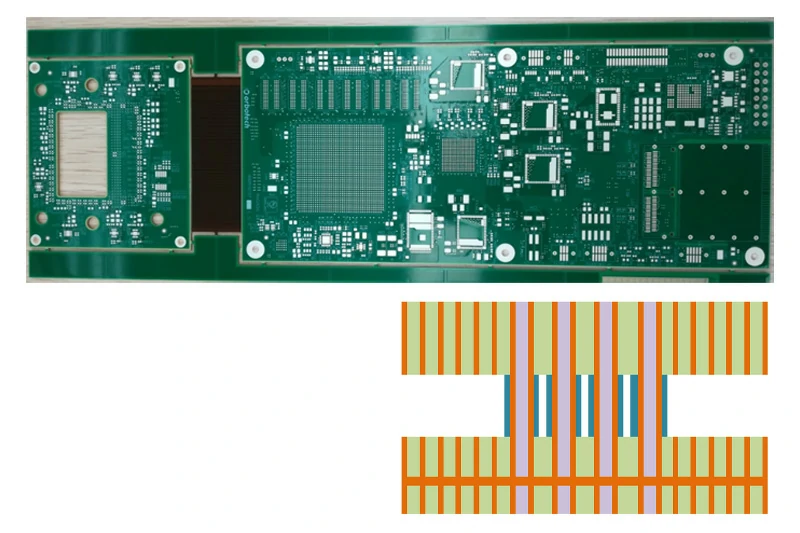
A rigid-flex PCB is a hybrid circuit board that integrates elements from both rigid and flexible circuits into a single, unified structure. It consists of rigid sections, similar to a standard PCB, where components are densely mounted. These rigid sections are interconnected by flexible circuit segments made from materials like polyimide. This creates a monolithic board that can be bent, twisted, and folded to fit into complex, three-dimensional spaces.
The key innovation here is that the electrical connections flow seamlessly from the rigid to the flexible parts without the need for connectors or cables. This *inherent interconnection* is the source of a rigid-flex board’s primary advantages in reliability, space savings, and design freedom.
When Should You Use a Rigid-Flex PCB? Key Scenarios
The decision to invest in rigid-flex technology is driven by specific engineering needs that a standard board-and-cable assembly cannot adequately meet. Here are the primary situations where a rigid-flex PCB is the superior choice.
1. For Unmatched Reliability and Signal Integrity
In applications where failure can have catastrophic consequences—such as in aerospace, medical implants, or military systems—reliability is non-negotiable. Standard PCB assemblies rely on connectors, ribbon cables, and hand-soldered wires to link boards. Each of these connection points is a potential point of mechanical and electrical failure, susceptible to issues from shock, vibration, and thermal cycling.
A rigid-flex PCB eliminates these failure points. The circuitry is continuous from one rigid section to the next, etched directly into the board’s layers. This creates an incredibly robust interconnect that is far less likely to fail under stress. Furthermore, the controlled impedance and shorter signal paths in a unified rigid-flex design can significantly improve signal integrity, which is crucial for high-speed digital and RF applications.
2. When Space and Weight are Critical Constraints
Modern electronics are constantly shrinking. From wearable devices and smartphones to drones and portable medical instruments, designers are tasked with fitting more functionality into smaller and lighter packages. Standard PCBs connected by cables are bulky. The connectors themselves have a significant footprint, and the cables require space to bend and route without being damaged.
Rigid-flex designs provide an elegant solution by enabling true three-dimensional product design. The board can be folded and contorted to fit precisely within the contours of a product’s enclosure, eliminating wasted space. By removing heavy connectors and wiring harnesses, rigid-flex circuits can drastically reduce the overall weight of an electronic assembly—a critical factor in aerospace, automotive, and portable electronics.
3. For Applications Requiring Dynamic Flexing
Some products require electronic components to move relative to one another consistently and reliably. Examples include the hinge of a laptop, the head of a 3D printer, a robotic arm, or a gimbal on a camera. Using traditional wires in these “dynamic flex” applications is a recipe for failure, as the repeated bending will eventually cause the metal conductors to fatigue and break.
Rigid-flex PCBs are engineered for this exact purpose. The flexible polyimide sections are designed to withstand hundreds of thousands, or even millions, of flex cycles without degradation. The materials and construction are specifically chosen to handle repeated movement, ensuring the long-term reliability of the product.
4. To Simplify Complex Assembly and Reduce Long-Term Costs
While the upfront cost of a rigid-flex PCB is higher, it can lead to a lower *Total Cost of Ownership (TCO)*. Consider an assembly with five rigid PCBs connected by a complex web of wires and connectors. The manual labor required to solder, crimp, and route these connections is extensive and prone to human error. Troubleshooting a faulty connection can be a nightmare.
A single, custom-designed rigid-flex board can replace this entire assembly. It arrives as one part, dramatically simplifying the manufacturing and assembly process. This reduces labor costs, minimizes the chance of wiring errors, improves production yields, and makes final product testing more efficient. Over the lifecycle of a product, these savings can easily offset the higher initial board cost.
When Is a Standard Rigid PCB the Better Option?
Despite the powerful advantages of rigid-flex, the standard rigid PCB remains the industry standard for good reason. It is often the more practical and economical choice.
For Simple, Static Applications
If your device is housed in a simple box-like enclosure and its internal components do not move, a standard rigid PCB is perfectly adequate. Desktop computers, power supplies, and many industrial control panels fall into this category. There is no need for 3D design complexity or dynamic flexing, so the added expense and design complexity of rigid-flex would be unnecessary.
When Upfront Cost is the Primary Driver
For cost-sensitive consumer electronics or projects with tight budgets, the higher per-unit price of rigid-flex PCBs can be a significant barrier. The materials used (like polyimide) and the more complex manufacturing processes (like lamination of different material types) make them inherently more expensive to produce than standard FR-4 boards. If you can achieve your design goals with a board-and-cable solution and stay within budget, a standard PCB is the logical choice.
During Early-Stage Prototyping
When you are in the early phases of design and expect to make frequent changes to the circuit, rigid-flex can be unforgiving. A change to one part of the integrated board may require a complete redesign and a new, expensive prototype. In contrast, prototyping with modular rigid boards and off-the-shelf cables allows for quick, inexpensive iteration. Engineers can easily swap out a single board or change a wiring configuration without scrapping the entire system.
Comparative Analysis: Rigid-Flex vs. Standard PCB at a Glance
This table provides a quick reference to help you weigh the key attributes of each board type.
| Attribute | Standard Rigid PCB | Rigid-Flex PCB |
|---|---|---|
| Upfront Cost | Low | High (3-7x higher) |
| Reliability (Shock/Vibration) | Moderate (connectors are weak points) | Excellent (monolithic design) |
| Size and Weight | Larger and heavier due to connectors/cables | Minimal (up to 70% reduction) |
| Design Flexibility (3D) | Limited to 2D planes | Excellent (enables folded, 3D designs) |
| Dynamic Flexing Capability | None (requires external cables) | Excellent (designed for millions of cycles) |
| Assembly Complexity | High (multiple parts, manual wiring) | Low (single part, fewer steps) |
| Design & Manufacturing Lead Time | Short | Long |
Real-World Applications: Where Rigid-Flex Excels
Understanding where these boards are used in practice solidifies the decision-making process. Rigid-flex is not a niche product; it is the enabling technology behind many of today’s most advanced devices.
- Aerospace & Defense: Used in avionics, missile guidance systems, and satellite electronics where weight, space, and absolute reliability under extreme G-forces and vibrations are critical.
- Medical Devices: Found in pacemakers, cochlear implants, and endoscopic cameras where biocompatibility, miniaturization, and reliability are life-saving requirements.
- Wearable Technology: Smartwatches, fitness trackers, and AR/VR headsets rely on rigid-flex to pack complex electronics into a form factor that conforms to the human body.
- Automotive: Used in modern cars for camera systems, sensors in steering columns, and lighting control where reliability and resistance to constant vibration are essential.
- Robotics and Drones: The joints of robotic arms and the compact bodies of drones require durable, lightweight, and dynamically flexible circuits.
The Cost Factor: Analyzing Total Cost of Ownership (TCO)
It’s a mistake to compare only the per-unit cost of a rigid-flex board versus a standard PCB. A true analysis must consider the *Total Cost of Ownership*, which includes all associated costs throughout the product lifecycle. A rigid-flex design may have a higher initial cost, but it can significantly reduce costs in other areas.
This includes:
1. Reduced Component Cost: Eliminating the need to purchase connectors, wires, and cable ties.
2. Reduced Assembly Labor: Replacing time-consuming manual wiring with a single-part assembly.
3. Reduced Testing and Rework: Fewer interconnects mean fewer points of failure, leading to higher initial yields and less time spent troubleshooting.
4. Reduced Service and Warranty Costs: The higher intrinsic reliability of a rigid-flex board translates to fewer field failures and lower warranty expenses.
When these factors are calculated, a rigid-flex solution that initially seemed expensive can emerge as the most economically viable option for a complex, high-reliability product.
Conclusion: Making the Strategic Decision for Your Project
The choice between a rigid-flex PCB and a standard rigid PCB is a strategic engineering decision, not just a component selection. A standard rigid PCB is the default, go-to choice for the vast majority of electronic products that are static, cost-sensitive, and have ample space.
You should transition to a rigid-flex PCB only when you face specific, demanding challenges. Ask yourself these key questions:
- Does my product need to survive high shock or vibration?
- Is minimizing size and weight a primary design goal?
- Does the design require circuits to bend, fold, or move dynamically?
- Can I simplify a highly complex assembly and reduce long-term costs by replacing multiple boards and cables with a single part?
If the answer to any of these questions is a definitive “yes,” then the investment in rigid-flex technology is not just justified—it is likely essential to the success of your product.