When choosing between an Aluminum PCB vs Ceramic PCB for high-power applications, the best choice depends entirely on your thermal management requirements, budget, and operational environment. Aluminum PCBs are the most cost-effective and highly durable solution for moderate-to-high power applications, offering a thermal conductivity generally between 1 to 9 W/mK, making them the industry standard for LED lighting and standard power converters. Conversely, Ceramic PCBs are the superior choice for extreme high-power, high-frequency, and miniaturized applications. Utilizing materials like Alumina (Al2O3) or Aluminum Nitride (AlN), ceramic boards eliminate the need for a dielectric layer, delivering exceptional thermal conductivity ranging from 24 W/mK up to 170 W/mK. If your project demands uncompromising thermal dissipation in a compact, harsh environment, ceramic is the ultimate choice; if budget and mechanical durability are priorities alongside reliable heat dissipation, aluminum is the optimal path.
The evolution of high-power electronics, ranging from advanced electric vehicle (EV) inverters to aerospace telecommunications, has pushed traditional FR4 circuit boards beyond their physical limits. When standard fiberglass substrates fail to dissipate extreme heat, engineers must pivot to advanced Metal Core Printed Circuit Boards (MCPCBs) or Ceramic Substrates. This comprehensive guide will dissect the structural differences, thermal capabilities, and ideal use cases for both aluminum and ceramic printed circuit boards to help you make an informed, data-driven engineering decision.
1. The Core Challenge in High-Power Electronics: Thermal Management
As electronic devices shrink in size while their power outputs exponentially increase, thermal management has become the primary bottleneck in PCB design. High-power components—such as Insulated-Gate Bipolar Transistors (IGBTs), high-brightness LEDs, and RF amplifiers—generate immense localized heat. If this thermal energy is not rapidly and efficiently moved away from the semiconductor junction, the device will experience thermal runaway. This leads to erratic electrical performance, degraded component lifespans, and ultimately, catastrophic system failure.
Standard FR4 boards possess a dismal thermal conductivity of roughly 0.25 to 0.4 W/mK. To compensate, designers traditionally rely on heavy copper pours, thermal vias, and bulky external heat sinks. However, in modern high-density interconnect (HDI) and high-power applications, these traditional methods are no longer sufficient. The substrate itself must act as an active participant in thermal dissipation. This necessity has given rise to the widespread adoption of Aluminum-backed PCBs and Ceramic-based PCBs, both of which offer distinct mechanisms for solving complex thermal equations.
2. What is an Aluminum PCB (MCPCB)?
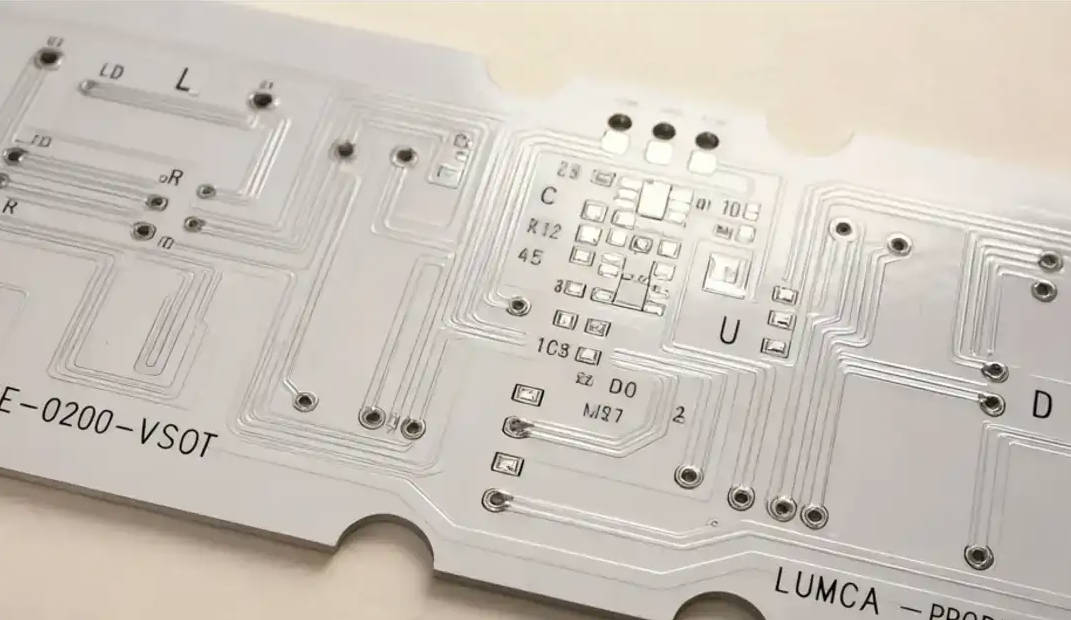
An Aluminum PCB is the most prevalent type of Metal Core Printed Circuit Board (MCPCB). It utilizes a solid aluminum metal base as the primary heat spreader. The fundamental principle behind an aluminum board is its ability to draw heat away from critical surface-mounted components and transfer it through the board to an external heat sink or the ambient air.
Structure and Composition
The architecture of an Aluminum PCB is generally composed of three distinct layers. Understanding this structure is vital, as it highlights both the strengths and the inherent limitations of the technology:
- The Circuit Layer: This is a standard copper foil (ranging from 1 oz to 10 oz or more for high power) etched to form the electrical pathways and component mounting pads.
- The Dielectric Layer: This is the most critical component of the aluminum PCB. It is a highly engineered, thermally conductive but electrically insulating polymer or epoxy layer. The thermal performance of an aluminum PCB is entirely dictated by the quality and thinness of this dielectric layer, as it acts as a thermal bridge between the copper and the metal core.
- The Base Layer: A solid sheet of aluminum (commonly 5052, 6061, or 1100 alloy) providing structural rigidity and acting as the primary thermal mass and heat spreader.
Advantages of Aluminum Substrates
Why use aluminum base PCBs? The primary advantage lies in the perfect intersection of thermal performance, mechanical durability, and cost-efficiency. Aluminum is highly machinable, meaning it can be easily routed, drilled, and V-scored without the risk of shattering. Furthermore, aluminum is significantly lighter than copper (another common MCPCB material), making it ideal for weight-sensitive applications. Environmentally, aluminum is highly recyclable and non-toxic. From a performance standpoint, high-quality dielectric layers can push aluminum PCBs to achieve thermal conductivities of 1 to 9 W/mK, which is a massive leap over standard FR4.
Common Applications for Aluminum Boards
Because of its robust mechanical properties and excellent cost-to-performance ratio, Aluminum PCBs dominate specific industries. They are the undisputed standard in the LED lighting industry (streetlights, automotive headlights, commercial lighting) because LEDs generate significant heat that must be dissipated to maintain color accuracy and longevity. They are also heavily utilized in power converters, motor controllers, solid-state relays, and consumer automotive systems where moderate-to-high heat dissipation is required on a mass-production budget.
3. What is a Ceramic PCB?
A Ceramic PCB abandons traditional fiberglass and metal core structures entirely. Instead, it utilizes an advanced ceramic substrate to which copper traces are bonded directly, usually through processes like Direct Bonded Copper (DBC), Direct Plated Copper (DPC), or Thick Film technology. The defining characteristic of a ceramic PCB is that it requires no dielectric layer. The ceramic material itself is highly thermally conductive while simultaneously acting as an absolute electrical insulator.
Types of Ceramic Materials (Alumina vs. Aluminum Nitride)
Not all ceramic boards are created equal. The specific properties of a ceramic PCB are dictated by the chemical composition of the substrate. The two most common materials used in high-power electronics are:
- Alumina (Al2O3 – Aluminum Oxide): This is the most widely used ceramic substrate. It offers a thermal conductivity of roughly 24 to 30 W/mK. It provides excellent mechanical strength, superb electrical insulation, and is relatively cost-effective compared to more exotic ceramics.
- Aluminum Nitride (AlN): For extreme high-power applications, AlN is the premium choice. It boasts an astonishing thermal conductivity ranging from 150 to 170 W/mK (and sometimes higher). AlN is specifically chosen when designers are dealing with massive power densities in highly constrained physical footprints, such as in advanced laser diodes or aerospace radar systems.
Advantages of Ceramic Substrates
The advantages of ceramic PCBs extend far beyond mere thermal conductivity. Because there is no organic dielectric layer, ceramic boards can withstand extreme operating temperatures (often exceeding 350°C) without delamination or outgassing. They possess incredibly low high-frequency signal loss, making them ideal for RF and microwave applications. Additionally, ceramics are impervious to moisture, highly resistant to chemical corrosion, and do not suffer from the same thermal degradation over time as polymer-based dielectrics.
Common Applications for Ceramic Boards
Ceramic PCBs are utilized where failure is not an option and budgets permit premium materials. Common applications include aerospace and defense electronics, concentrated solar power receivers, advanced EV powertrain modules (such as IGBT modules), high-power laser diodes, 5G telecommunication base stations, and heavy industrial power supplies. In these environments, the incredible heat dissipation and environmental resilience of ceramic easily justify the higher manufacturing costs.
4. Head-to-Head Comparison: Aluminum vs. Ceramic PCBs
To definitively answer which circuit board handles heat better and is most suitable for your specific project, we must evaluate both technologies across four critical engineering metrics: thermal conductivity, thermal expansion, mechanical durability, and cost.
Thermal Conductivity and Heat Dissipation
In the realm of raw thermal conductivity, Ceramic PCBs are the undisputed champions. As mentioned, an Aluminum PCB’s heat transfer is bottlenecked by its polymer dielectric layer. Even the most advanced thermally conductive prepregs max out around 9 to 12 W/mK. Because Ceramic PCBs lack this organic bottleneck, heat travels directly from the copper trace into the ceramic. Alumina (Al2O3) starts at 24 W/mK, while Aluminum Nitride (AlN) routinely achieves 170 W/mK. If your application involves ultra-high power density where every fraction of a degree matters to semiconductor stability, ceramic is vastly superior.
Coefficient of Thermal Expansion (CTE)
Why does the Coefficient of Thermal Expansion (CTE) matter in PCB design? As a board heats up and cools down, the materials expand and contract. If the substrate expands at a drastically different rate than the mounted semiconductor components (like silicon chips), the resulting mechanical stress will eventually fracture the solder joints, leading to device failure. Ceramic PCBs have a CTE (roughly 4-7 ppm/°C) that closely matches that of silicon (approx. 3 ppm/°C). This makes ceramic incredibly reliable for bare-die packaging and extreme thermal cycling. Aluminum, however, has a high CTE (approx. 22-24 ppm/°C), creating a significant thermal mismatch with silicon components, which can be detrimental in severe temperature-fluctuating environments.
Mechanical Strength and Durability
While ceramic wins in thermal and CTE metrics, Aluminum PCBs hold a massive advantage in mechanical durability. Aluminum is a ductile metal; it can absorb shock, vibration, and physical impacts without sustaining damage. It can be manufactured in large panels and easily scored or routed. Ceramic, by its very nature, is highly brittle. It is susceptible to micro-cracking and catastrophic shattering if subjected to high physical impact, severe mechanical vibration, or improper handling during assembly. For applications subjected to heavy vibrations (like standard automotive engines or heavy machinery), aluminum is often the safer mechanical choice.
Cost and Manufacturing Complexity
Budget constraints are an undeniable reality of electronics manufacturing. Aluminum PCBs are widely adopted because they are incredibly cost-effective. The manufacturing process for an aluminum MCPCB is very similar to standard FR4 fabrication, allowing for high-volume production at a low price point. Ceramic PCBs, conversely, are significantly more expensive. The raw materials (especially AlN) are costly, and bonding copper to ceramic (via DBC or DPC) requires specialized, energy-intensive manufacturing processes performed at very high temperatures. Furthermore, because ceramic is hard and brittle, drilling vias and routing shapes require specialized laser tooling, further driving up the unit cost.
Summary Comparison Table
| Feature / Specification | Aluminum PCB (MCPCB) | Ceramic PCB (Al2O3 / AlN) |
|---|---|---|
| Thermal Conductivity | 1 – 9 W/mK (Limited by dielectric) | 24 W/mK (Al2O3) to 170+ W/mK (AlN) |
| Dielectric Layer Required? | Yes (Thermally conductive polymer) | No (Substrate is naturally insulating) |
| Coefficient of Thermal Expansion (CTE) | High (~22 ppm/°C) – High mismatch with Silicon | Low (~4-7 ppm/°C) – Excellent match with Silicon |
| Mechanical Durability | Excellent (Ductile, highly impact-resistant) | Poor (Brittle, susceptible to cracking) |
| High-Frequency Performance | Moderate to Poor | Excellent (Low dielectric loss) |
| Cost Factor | Low to Moderate (Cost-effective for high volume) | High (Premium materials and complex fab) |
5. Which Is Best for Your High-Power Application?
The decision between an aluminum vs ceramic circuit board ultimately comes down to performing a strict cost-to-benefit analysis based on your exact engineering requirements.
Choose an Aluminum PCB if: Your application involves high-power surface-mount devices (like LEDs or standard power MOSFETs) that require excellent heat dissipation, but your product is highly cost-sensitive. If your device will be subject to mechanical shock, vibration, or requires a large physical board footprint, the durability and machinability of an aluminum substrate make it the clear winner.
Choose a Ceramic PCB if: You are designing cutting-edge, ultra-high-power density electronics where space is severely constrained, and failure is unacceptable. If your design involves bare-die mounting, extreme temperature cycling, high-frequency RF signals, or operation in harsh aerospace/military environments, the unmatched thermal conductivity and CTE matching of Alumina or Aluminum Nitride are absolutely essential, thoroughly justifying the premium cost.